
AI / GEO / AEO
Entity clarity, structured data, llms.txt, answer-ready FAQ: AI readability — not a citation guarantee.
Readiness for the answer era
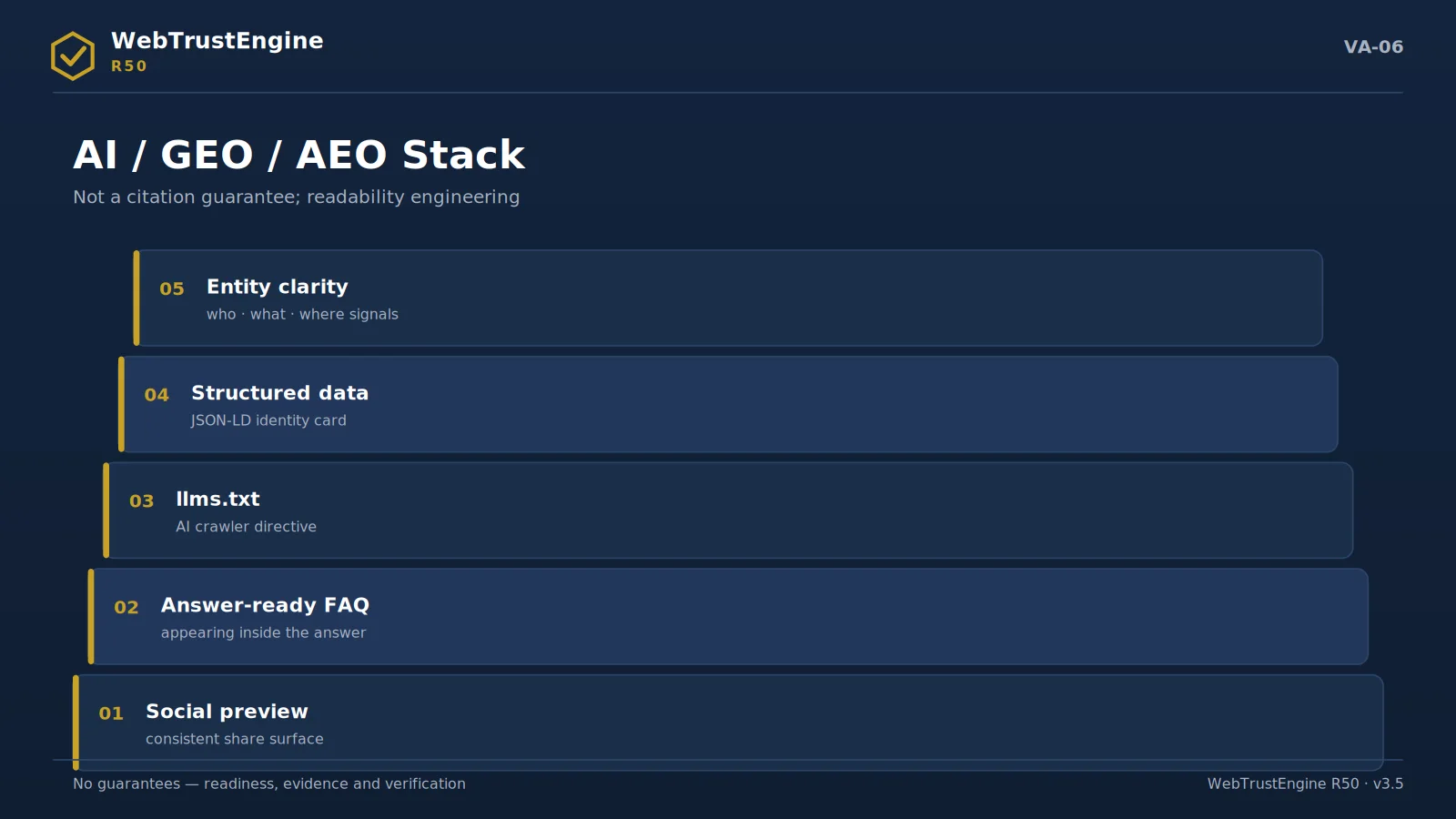
The AI/GEO/AEO readiness stack: five levels from identity to answer-ready content.
AI systems do not read the web like humans; they look for identity, structure and sourceability. If an answer engine cannot quickly and consistently resolve 'who runs this site, what service is offered, which page answers what', the content will not enter the answer no matter how good it is. AI/GEO/AEO readiness is therefore not a trend but readability engineering.
The building blocks: entity clarity (Organization/Person identity, the sameAs chain), service clarity (naming and defining the service), answer-ready FAQ (Q&A blocks and schema), structured-data consistency, llms.txt and AI-crawler directives, canonical/hreflang discipline, social-preview integrity and topical consistency across pages.
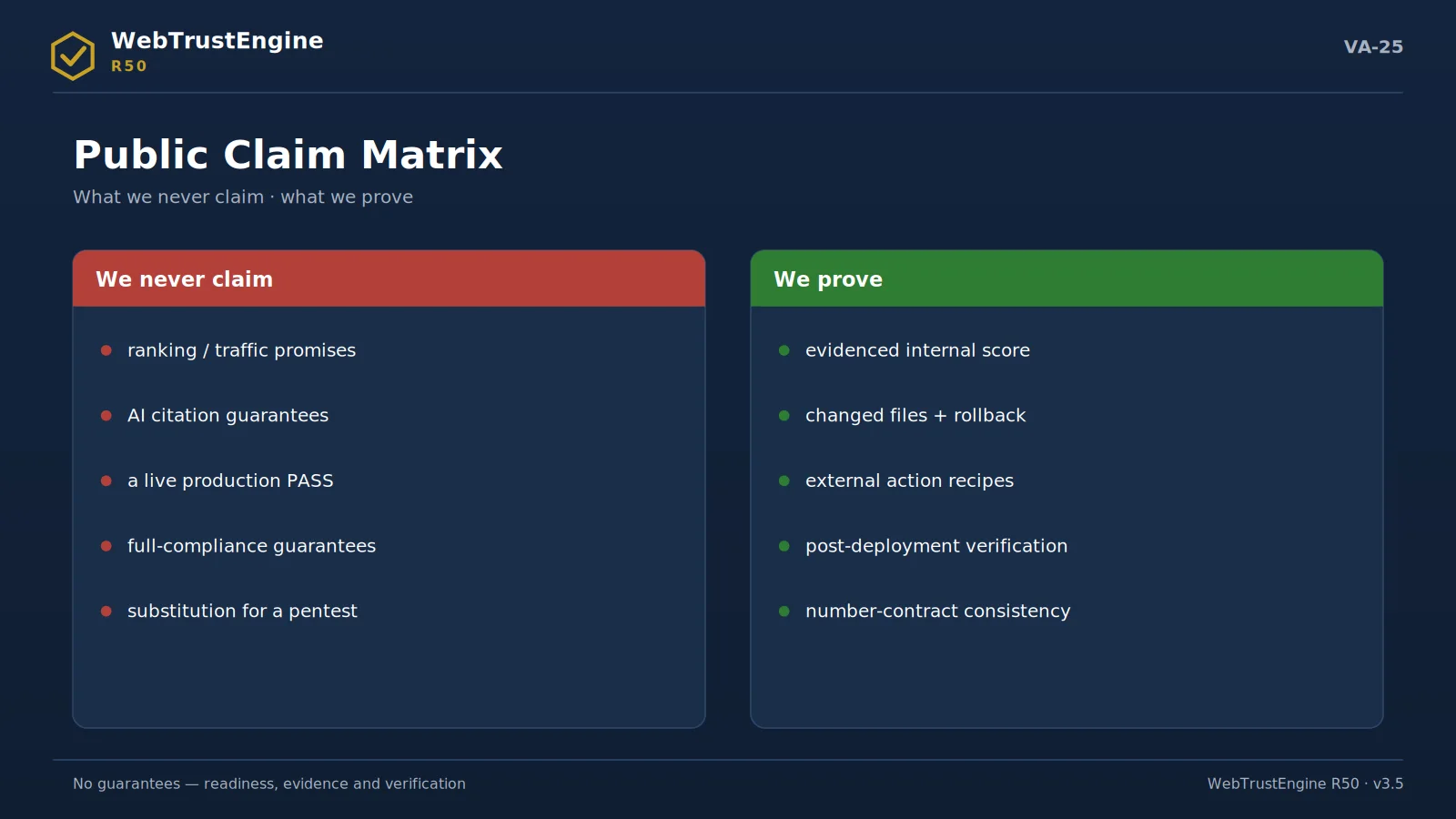
Public claim-safety applies here too: never 'AI recommends us'; always 'readability readiness for AI'. There is no citation guarantee; there are readiness signals — measurable, auditable, improvable.
- entity clarity
- service clarity
- answer-ready FAQ
- structured data
- llms.txt
- canonical/hreflang
- social preview
- topical consistency
- no citation guarantee
What the engine does: Prepares and marks readability signals.
What it doesn't: Gives no citation/recommendation guarantee.
What the output is: AI-readiness finding set + llms.txt suggestion.
For decision-makers: Visibility readiness in the answer era.
For technical teams: Signals are auditable; measured, not promised.
Entity clarity: how machines know who you are
The entity flow: from identity clarity to machine-readable identity and a validated answer surface.
Used correctly, the schema layer is the brand's machine-readable identity; used wrongly, it is invisible debt. Organization and WebSite establish site identity; WebPage gives page context; Service names the offering; FAQPage opens Q&A to answer engines; BreadcrumbList explains hierarchy; Person binds founder/expert identity.
Types like Product, Event, Recipe are conditional: used only when that content truly exists. Wrong-schema risk is real — an unsuitable type or missing required field can break rich-result eligibility and invert the trust signal. The engine parses JSON-LD, audits type-page fit and field integrity; for entity consistency it checks cross-page coherence of signals such as sameAs/phone/address.
- Organization/WebSite/WebPage
- Service/FAQPage/BreadcrumbList
- Person
- Product/Event = conditional
- JSON-LD parse + field integrity
- entity consistency
What the engine does: Parses schema, audits fit and integrity.
What it doesn't: Never invents schema for non-existent content.
What the output is: Type-based findings + baseline block generation.
For decision-makers: The health of machine-readable identity.
For technical teams: Conditional rules prevent wrong-schema debt.
READINESS LAYER
Eight readiness cards
llms.txt
Site identity and permission framing for AI readers.
JSON-LD
Organization / WebSite / WebPage / FAQPage layers.
Entity clarity
Consistent naming of who you are and what you do across surfaces.
FAQPage
Q&A structure answer engines can quote.
Readability
Clear, short, sourced statements that can live inside an answer.
hreflang
Correct machine pairing of language versions.
sitemap / robots
No crawl budget wasted.
Evidence links
Claims tied to downloadable documents.
Claim safety
There is no AI visibility or citation guarantee; what exists is measurable readiness to live inside the answer.
THE NEW GATE The answer era: traffic goes to the answer, not the page
The results list is steadily replaced by a single answer box; a model talks about you before the user ever reaches your page. In this era visibility reduces to two questions: does the model recognise you correctly, and do you have quotable material that can live inside the answer? The practices called GEO and AEO are the engineering of those two questions — and WebTrustEngine moves them from the promise layer down to the readiness layer.
llms.txt llms.txt: the door sign written for models
robots.txt speaks to crawlers; llms.txt speaks to AI readers. It holds three things: a one-sentence, contradiction-free definition of who you are; a short map of key pages; and a contact/permission frame. Its power is its plainness — a model summarising your site sees this door sign first, and your misrecognition risk drops measurably. This site's own llms.txt carries the number contract and the boundaries under the same discipline.
IDENTITY Entity consistency: saying the same name the same way everywhere
Machine readers assemble identity from crossed sources: page text, JSON-LD, the sitemap, external mentions. If the name reads 'WebTrustEngine' in one place and a variant elsewhere, the model wrestles with the possibility of two entities and dilutes you in its answers. Entity consistency is therefore infrastructure, not cosmetics: the Organization schema, founder data, domain and visible text must speak in one voice — and the engine's relevant checks scan exactly for that single voice.
Q&A The FAQPage strategy: getting inside the answer
Answer engines' favourite structure is an explicit question plus a sourced short answer. The 89-question FAQ architecture is therefore built not only for human visitors but for quotability: every question has a one-to-one schema counterpart, the visible count equals the schema count, and no answer carries guarantee language. There is no 'citation guarantee' — but the guarantee of never being quotable is never building this structure at all.
FROM THE FIELD
What AI readiness looks like in practice
The honest premise first: nobody can guarantee that a language model will cite you, any more than anyone could ever guarantee a #1 ranking. What can be engineered is the probability of being read correctly — and that is exactly what this domain scores. Readiness here means three layers working together: identity a machine can resolve, structure a machine can parse, and sentences a machine can safely quote.
Identity is entity clarity: the same name, the same description of what you do, consistent across pages, schema and llms.txt — so a model assembling an answer does not have to guess who you are. Structure is the JSON-LD stack: Organization, WebSite, WebPage, FAQPage, each carrying only claims the visible page also makes. Quotability is editorial discipline: short, sourced, guarantee-free statements placed next to downloadable proof. The engine measures all three statically, flags the gaps, and — per the number contract — never dresses the result up as an "AI visibility score" promised to convert into citations.
THE ANSWER ENGINE'S EYE
How an answer engine reads this site
Walk it from the crawler's side. It checks robots.txt and sitemap.xml first: which doors are open, is the map current? Then llms.txt — a one-sentence identity, the number contract in compressed form, the addresses of the key pages. On-page, the JSON-LD layer takes over: Organization pins the name and founder, WebPage declares the topic, FAQPage serves 105 questions in machine-readable form.
The visible text is built for quotation: sentences like "different units are never summed" are shaped to live inside an answer — with the downloadable document's address beside them. No link in this chain manufactures a citation guarantee; what it manufactures is clarity that makes misquotation harder if a model does decide to cite you.
For writers, five working rules follow: put the answer in the first paragraph; source every number; expand every acronym at first use; call every entity by one name everywhere; and never write a guarantee — quoted, it becomes a promise made in your name. The shared core: sentences that stand alone when carried into an answer.
LINE BY LINE
What llms.txt says, line by line
This site's own llms.txt does four jobs. Line one states the identity in both languages — an evidence-based web governance engine. The second block writes out the number contract together with the distinction AI readers most often break: checks, patterns and bridges are separate units; the detection layer is 348. The third block lists the boundaries — not a pentest, no live pass, no guarantees, pricing unpublished — so that even a model paraphrasing the site cannot construct a false promise from it. The final block hands over the key pages and the SHA-verified documents. The file is short on purpose: its task is not persuasion but the raw material of a correct quote.
WHY 89 QUESTIONS
Why FAQPage carries 105 questions
Eighty-nine is not a magic number; it is what remained after two filters. Every question had to be real — asked by an executive, an engineer or a journalist somewhere in the R-cycle history — and every answer had to survive the claim-safety scan without a guarantee slipping in. Answer engines reward that density: a FAQPage whose entries are genuine questions with bounded answers gives a model 89 safe quotation points instead of one inflatable slogan. The visible page and the schema carry the same 89 — never a hidden extra for machines.
Quick answers
Will AI recommend us?
Not guaranteed; readability is prepared.
What is llms.txt for?
AI access/summary directives.
Is schema required?
Critical for identity clarity.
Multilingual sites?
Via hreflang discipline.
Measurable?
The signals are auditable.
Next step
Entity clarity, structured data, llms.txt, answer-ready FAQ: AI readability — not a citation guarantee.