
Deploy-Verify
After upload, live headers, redirects, previews and external-tool results are confirmed with evidence.
Producing files is not enough
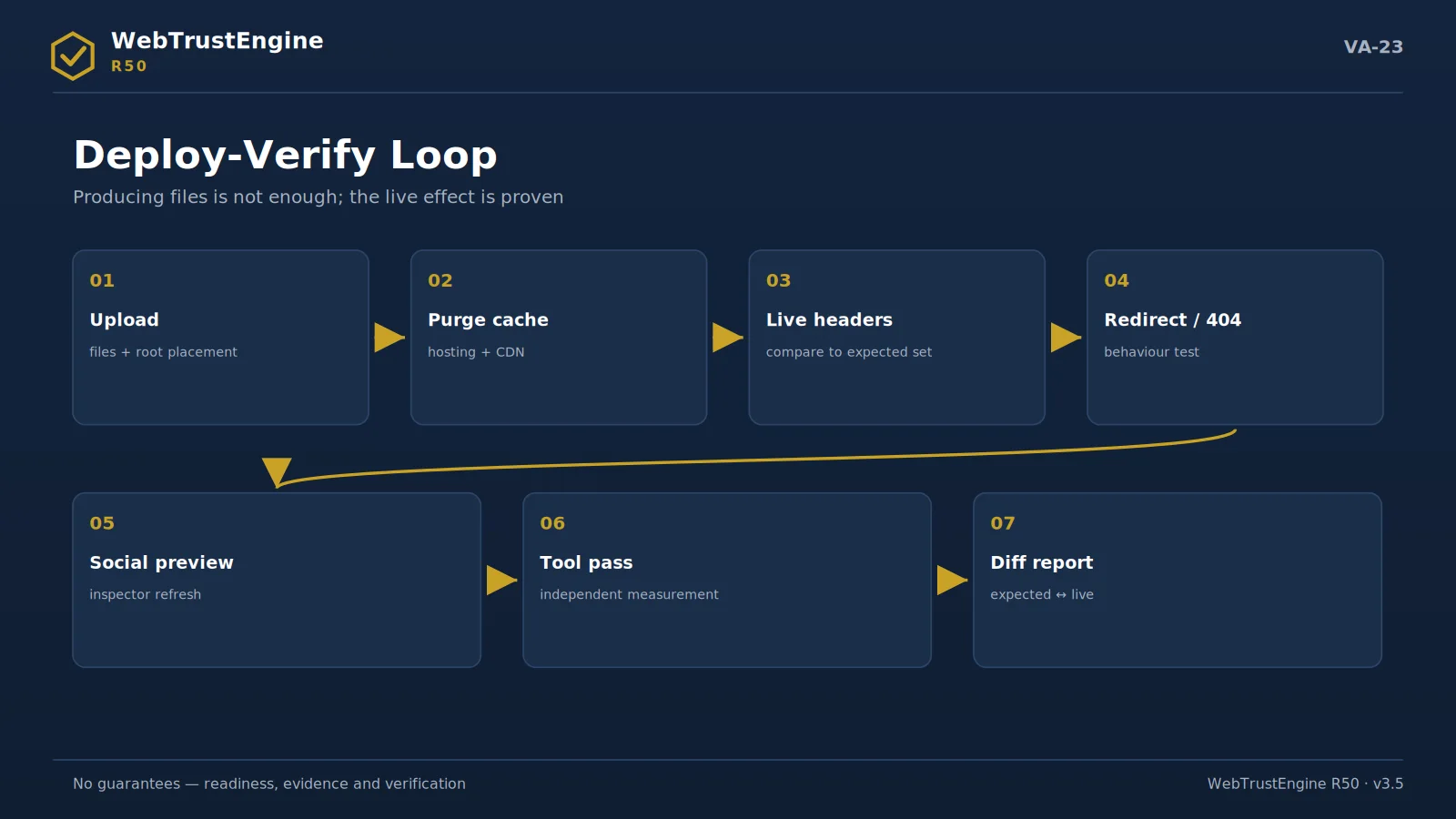
The Deploy-Verify loop: seven steps from upload to the diff report.
The evidence chain: six links from the baseline record to the diff report.
File produced ≠ working live. This inequality is the most commonly skipped gap in web work, and one of WebTrustEngine's strongest differentiators stands exactly here. An .htaccess being in the package does not mean hosting reads it; an OG tag being in the HTML does not mean the social platform cache sees it.
The intervening layers are enumerable and predictable: hosting cache, CDN cache, whether .htaccess is actually processed, social-preview caches, browser cache. Deploy-Verify turns each into an evidence step: live header fetch, redirect tracing, metadata/schema comparison, sitemap/robots/llms.txt reachability, social-preview debugger checks.
The external-tool layer is part of the loop: SecurityHeaders and Observatory grade headers; SSL Labs evaluates certificate/protocol; Lighthouse/PageSpeed produce lab metrics; Search Console and Bing Webmaster show indexing. The engine does not produce these results; it bridges and binds them to the report.
Runtime verification bridges
The runtime bridge: four steps from static signal to independent measurement.
A runtime bridge is the bridge layer for checks that cannot be exactly measured from a static file. The principle is simple: the engine fabricates no measurements. Offline, the bridge says 'requires_live' and writes which tool measures which metric and how; live, it routes to the real measurement.
The bridge universe groups into 21 checks with typical examples: SecurityHeaders (header grade), Mozilla Observatory, SSL Labs (TLS grade), PageSpeed/Lighthouse (lab metrics), CrUX (field CWV), social-preview inspectors, redirect-chain tracing, uptime/response headers, the contrast runtime check, a link checker for broken external links.
This layer answers two questions at once: 'who produces live scores' (independent tools) and 'why is the engine still needed' (because the bridge binds measurement to baseline and report; a lone tool score is not a decision surface).
- SecurityHeaders · Observatory · SSL Labs
- PageSpeed · Lighthouse · CrUX
- preview inspectors · redirect chain
- uptime · response headers · contrast · link checker
What the engine does: Binds live measurements to real tools.
What it doesn't: Fabricates no scores; replaces no tools.
What the output is: The bridge list + tool/metric/how template.
For decision-makers: The source of scores is transparent.
For technical teams: Baseline-bound measurement fixes lone-score context loss.
Working protocol with independent tools
External measurement ecosystem: independent tools produce live scores; the engine binds results via bridges.
The tool-to-domain matrix: the domain and timing map of independent validation.
Run-and-read notes for the six main tools used in the Deploy-Verify pass
SecurityHeaders
Enter the domain, read per-header; gaps map to the .htaccess recipe. If the grade is low, check cache/processing first.
Mozilla Observatory
Compare the post-scan suggestions with our header recipe; overlapping advice merges into one policy.
SSL Labs
Full analysis takes 1-2 minutes; read chain, protocol and OCSP rows. Server-side findings go to external recipes.
PageSpeed / Lighthouse
Write lab metrics into the readiness column; field (CrUX) data is a separate column. Never report the two as one score.
Rich Results Test
Test schema-bearing sample URLs; on errors re-audit type-page fit and required fields.
Search Console
After verification submit the sitemap; bind coverage and CWV reports to the Monitor rhythm.
The live verification timeline
Deploy-Verify Timeline
Producing files is not enough; the live effect is proven
- Uploadfiles + root placement
- Purge cachehosting + CDN
- Live headerscompare to expected set
- Redirect / 404behaviour test
- Social previewinspector refresh
- Tool passindependent measurement
- Diff reportexpected ↔ live
No guarantees — readiness, evidence and verification. Number contract: 348 checks · 80 core + 268 granular.
EXTERNAL TOOLS
Who issues the grade?
Search Console
Indexing and rich-result signals; the sitemap is submitted here.
external verificationPageSpeed / Lighthouse
These issue performance grades; the engine only flags readiness.
external verificationSSL Labs
TLS grade comes from here; the engine classifies configuration readiness.
external verificationSecurityHeaders
Live header grade; the recipe is engine output, the grade is external.
external verificationRich Results
Live confirmation of schema eligibility.
external verificationCDN / DNS
Cache and record layers; handled via external action recipes.
external verification
THE LAYERS Hosting, DNS and CDN: three layers a file cannot see
A file root can be flawless and the answer reaching a visitor is still shaped by three layers. Hosting processes — or flattens — your headers; DNS decides which server your name resolves to; a CDN inserts its own cache and sometimes its own headers in between. The distance between 'works on my machine' and 'works in production' is exactly these three layers.
Deploy-Verify closes that distance with two instruments: runtime bridges pull the real live answer and compare it with the file expectation, while external action recipes describe the panel work — cache purge, record update, header rule — step by step. No step enters a panel on your behalf; it hands you the recipe and asks for the evidence.
THE HYGIENE PAIR sitemap and robots: small files, large consequences
The sitemap tells a search engine 'this is my inventory'; robots says 'look here, not there'. Inconsistency between the two — a mapped address blocked in robots, or an important page missing from the map — silently burns crawl budget. Two of the first post-deploy bridges read this pair live: is the file reachable, does its content match the published addresses one-to-one, has Search Console been notified.
NO LIVE PASS Why no 'live pass' is ever issued
The engine reports the evidence it pulls after publication, but under no condition stamps 'the site passed live'. The reason is principled: live grades drift with time, geography and intermediate layers; the header returned today can vanish tomorrow behind a CDN toggle. A permanent 'passed' would be a promise falsifiable the next morning.
What is delivered instead is a pair: time-stamped live pulls ('at this date, this address returned this answer') and independent-tool recipes. The grade belongs to SSL Labs, PageSpeed or SecurityHeaders; the engine paves the road to that grade and proves the road was paved. This is claim safety at the deployment layer.
90 DAYS The first 90 days of measurement
What is measured when, with which evidence, in the first quarter
| Period | Measured | Evidence |
|---|---|---|
| Day 0-15 | Baseline score + finding classification | Review report |
| Day 15-30 | Internal score delta after SafeFix | before/after + rollback |
| Day 30-45 | Live header/preview confirmation | Deploy-Verify diff report |
| Day 45-60 | Independent tool-pass results | SecurityHeaders/SSL Labs/PageSpeed bridges |
| Day 60-75 | External-action application status | recipe + panel verification |
| Day 75-90 | First Monitor comparison | periodic diff + drift list |
After ninety days four evidence files exist and the loop is now the organisation's rhythm; what follows is a decision of scale and depth.
FROM THE FIELD
What Deploy-Verify looks like in practice
Deploy-Verify exists because the most common failure in web work is silent: files are produced, uploaded, celebrated — and the live site keeps serving the old cache, or the new headers never reach the browser, or DNS points somewhere subtly wrong. The mode's stance is blunt: a file on disk proves nothing. Proof is a live pull.
So the mode packages two things. Runtime bridges are small, repeatable checks that fetch the live URL and compare what production actually returns against what Build prepared — headers, redirects, canonical, sitemap reachability. External action recipes are step-by-step instructions for the platforms only you control: purging the CDN, submitting the sitemap in Search Console, re-scraping the OG card, reading an SSL Labs report. The engine never performs those actions in your accounts and never fakes their results; it hands you the exact sequence and the record to compare against.
FIRST 48 HOURS
The post-launch verification walk
Within the first hour: purge hosting and CDN caches, then pull live headers — is HTTPS redirecting, is HSTS present, are the security headers actually returned? In the same session open robots.txt, sitemap.xml and llms.txt one by one in a browser; existing on disk is irrelevant, the live URL must answer. If an approved security contact channel has been defined and security.txt is in scope, verify it separately at /.well-known/security.txt.
Within the first day: submit the sitemap in Search Console and run sample pages through the Rich Results test; refresh the OG card in the social debuggers. Day two is measurement: PageSpeed and SSL Labs run, and their outputs enter the evidence folder with dates and screenshots. At no step does the engine say "pass" — its contribution is the recipe that orders the walk and the static readiness record you compare against. The grade comes from outside, which is exactly why it can be believed.
Quick answers
Why needed?
A file existing doesn't prove live effect.
Who measures?
Independent tools; the engine bridges.
After GoDaddy?
A 7-step flow: upload→purge→fetch→test→debug→tools→report.
Real-time?
No; periodic.
Output?
Diff report + tool-result bridges.
Next step
After upload, live headers, redirects, previews and external-tool results are confirmed with evidence.