
Contact
No fake form, no invented phone — and no invented e-mail either. This page is a topic routing center: four lanes carry your request to the right page and the right document.
FOUR CARDS
Which request moves how?
To speed the conversation, have three things ready: the domain to be reviewed, your scope expectation (single site or multilingual estate) and your decision timeline. Since pricing is not published on this site, quotes follow the scope those three facts define; press and brand requests simply follow the routing on their card. Response expectations are set here too: review requests come back with scope questions, technical ones link to the relevant document section. This page is deliberately form-free; routing works entirely at the text level and no field collects data.
Review request
Your URL plus your goal is enough; an evidenced baseline is scheduled without touching a file. The reply carries the scope class and an indicative timeline together.
Executive briefing
A 30-minute walk-through of the number contract and evidence logic for leadership. The deck carries the same claims as the published number contract — never more.
Press / brand assets
If something is missing from the kit or Brand Center, write in; nothing is invented. Interview answers rely only on the published number contract.
Technical scope question
Boundaries, bridges and the file dictionary clarified for CTO/security teams. Where useful, the matching section of the technical trust note is referenced.
SCOPE
Scope components (no pricing)
Pricing is not published here; the components below make clear what a quote is built from.
Scope logic: size, languages, modes and monitoring cadence.
Scope is discussed via four components; none maps to a figure, since this document is public.
Site size
Page count and asset volume; scales Review time, finding density and SafeFix scope. A small corporate site and a multi-section portal do not share a rhythm.
Language count
Every language copy brings its own meta/schema/hreflang discipline; consistency auditing grows with languages.
Mode combination
Review only; Review+SafeFix; the full loop (including Build and Monitor) — three depths of engagement.
Monitoring cadence
Monthly, quarterly or release-based Monitor rhythm; chosen to match how fast your site changes.
THE SERVICE
The service: automated scanning, verified delivery
WebTrustEngine reaches you as a managed service, not a self-serve dashboard: technical scanning, classification, reporting, rescanning and verification complete automatically, and writing to live systems happens only within an authorized scope. An operator turns it into decisions, sequences and delivered files. In practice a short scoping exchange starts the work — which site, which goal, which constraints — followed by a Review that establishes the evidenced baseline. From there the path is chosen together: SafeFix for the low-risk repairs, Build where a static surface must be produced, Deploy-Verify to close the loop in production.
Three commitments frame every engagement. Reversibility: nothing is applied without its rollback manifest. Transparency: every claim in every report ties to a file you can open and a digest you can verify. And boundary honesty: no pentest, no live pass, no ranking or citation promises — if a request falls outside those lines, you are told so before any work begins, together with the legitimate route (an authorised testing firm, a platform action, an expert of the right discipline). Pricing follows the scope components above and is settled in writing; the site publishes the components, never the numbers.
If you are running a vendor evaluation
Procurement or internal audit can ask any web vendor these ten questions; what a good answer looks like is given alongside. WebTrustEngine answers them with its own evidence package.
Question: How do you prove your check count?
Good answer: A good answer is code-derived counting plus registry consistency; not a slide number.
Question: Do you provide the list of changes?
Good answer: A good answer is a file-level changed list + rollback; not 'improvements were made'.
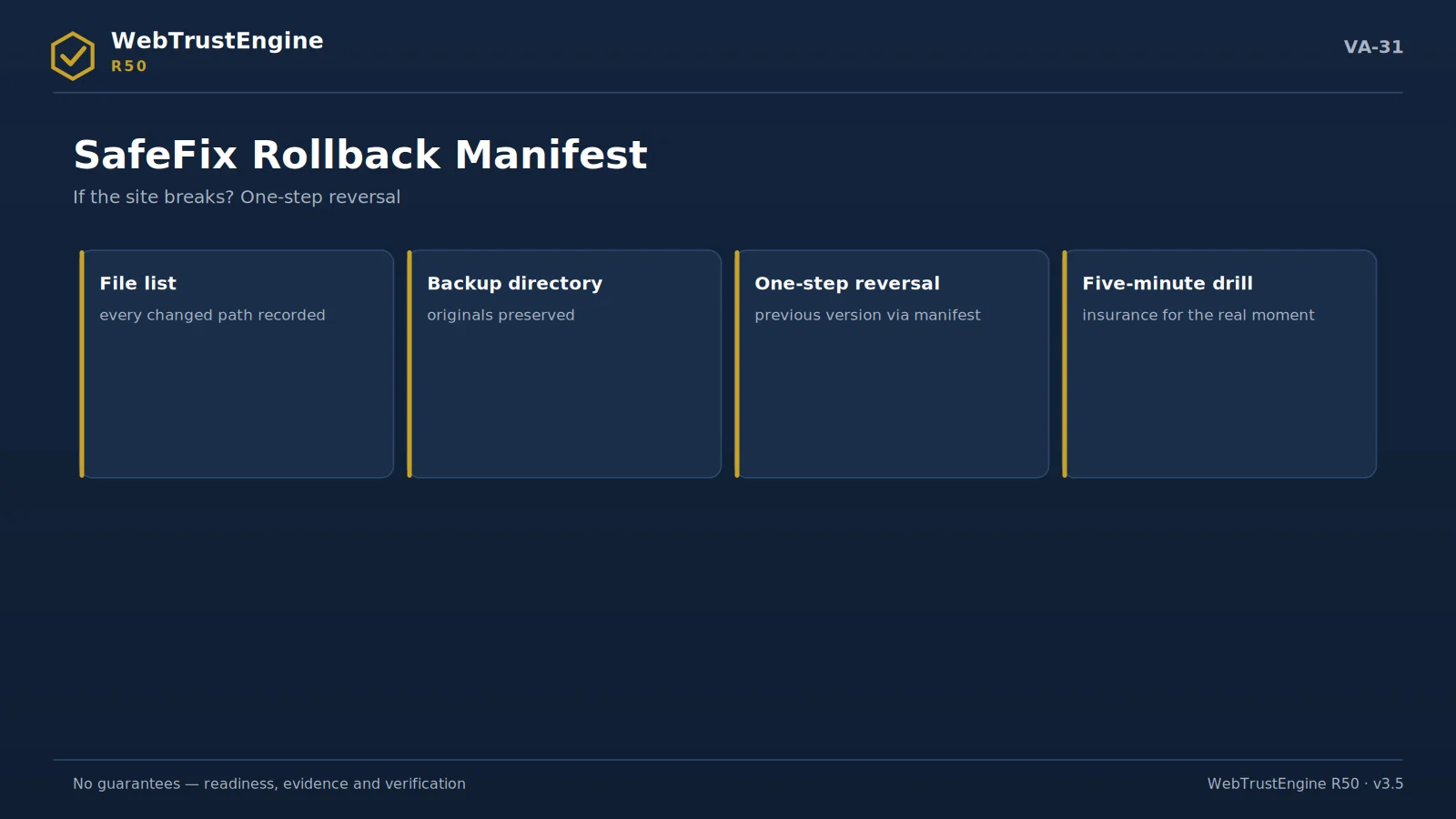
Question: What is your reversal plan if the site breaks?
Good answer: A good answer is a backup dir + a rehearsed one-step reversal.
Service flow
Technical scanning, classification, reporting, rescanning and verification complete automatically. Writing to and publishing on the live system happens only within an authorized scope. The product narrative lives on this site; the service agreement lives in the written scoping process.
THE PROCESS What happens after a request is raised
The flow has three steps and none contains a surprise. First, classification: your request enters whichever of the four cards it fits, and scope questions come back — site address and goal for a review, audience profile for a briefing, outlet and date for press. Second, the scope letter: what will and will not be done, and the deliverables, are fixed in writing; pricing is shared at this stage, in correspondence — never on the site. Third, delivery: every engagement closes with the evidence culture this site describes — manifest, checksums, before/after.
VENDOR QUESTIONS Question us too: the vendor checklist
Procurement or internal audit can ask any web vendor these ten questions; what a good answer looks like is given alongside. WebTrustEngine answers them with its own evidence package.
Question: How do you prove your check count?
Good answer: A good answer is code-derived counting plus registry consistency; not a slide number.
Question: Do you provide the list of changes?
Good answer: A good answer is a file-level changed list + rollback; not 'improvements were made'.
Question: What is your reversal plan if the site breaks?
Good answer: A good answer is a backup dir + a rehearsed one-step reversal.
Question: Who produces the live scores?
Good answer: A good answer names independent tools and the bridging logic; not self-scoring.
Question: What can you not automate?
Good answer: A good answer is a clear out-of-scope register; 'everything' is a red flag.
Question: What is the legal scope of your security testing?
Good answer: A good answer is the SAST/DAST split plus the authorization requirement.
Question: How do you handle DNS/CDN work?
Good answer: A good answer is a recipe with steps+verification; not 'we handled it'.
Question: Do you guarantee ranking/traffic?
Good answer: The good answer is no; readiness and evidence is the correct language.
Question: How do I verify delivery integrity?
Good answer: A good answer is a manifest + checksums; not a lone zipped folder.
Question: What will we measure in ninety days?
Good answer: A good answer is a dated measurement plan mapped to evidence files.
Move along the right lane for your topic
This page is a routing center: until a verified direct channel is published, no e-mail, phone or form appears on this site — an invented channel is counterfeit trust.
Quick answers
How do we start?
With a Review input.
How long?
Size-dependent; structure constant.
Why is there no direct contact detail?
No verified channel is published yet; presenting one that does not exist would violate this site's claim-safety principle. When a channel is published, this page and the release…
Can I call?
No phone is published and none is invented; the four lanes route your request to the right document and page.
May I ask for a price list?
No published pricing; quotes follow the scope components.
Do you sign NDAs?
Considered in enterprise processes; once a verified contact channel is published, the request travels through it.